The Muslim Council of Britain today marks the launch of its groundbreaking two volume 400-page report titled ‘British Muslims in Numbers’ at Westminster City Hall which draws on the 2021 census of England, Wales and Northern Ireland, and the 2022 census in Scotland, to provide a comprehensive statistical profile of UK’s British Muslims, analysing trends over the last twenty years and where appropriate highlights interfaith and ethnic group comparisons.
Dr Wajid Akhter, Secretary General of the Muslim Council of Britain says: “This groundbreaking British Muslims in Numbers report has been launched at a critical time post the local elections results. The report’s rigorous analysis on British Muslims plays a key role in contributing to public policy making which affect the community from health, to education, employment and civic engagement, we hope this will increase awareness about who British Muslims are within the civil society and media”.
He adds, “This data is a starting point for wider conversations about the rich diversity, identity, growth and social equality of British Muslims and uncovers a host of issues pertinent for an inclusive way of life for most British Muslims. This report paints the most accurate and in-depth insight to our community to date which we hope will reflect the positive contributions British Muslims make and the challenges which remain to be tackled in meeting the needs of 4 million Muslims in the UK especially given the current political landscape.”
In her foreword to the report, Professor Sophie Gilliat-Ray OBE, FBA, FLSW and Head of the Islam UK Centre at Cardiff University writes: “As one of the most well-established, reputable and credible organisations representing British Muslims, the Muslim Council of Britain has consistently championed the interests, needs and growth of Muslims in the UK. No serious academic scholarship takes place about Islam and Muslim communities in Britain without reference to the meticulous research undertaken such as this groundbreaking insight in the British Muslims in Numbers report. I urge everyone to read it to gain a real understanding of who they are”.
Key findings from the British Muslims in Numbers report include:
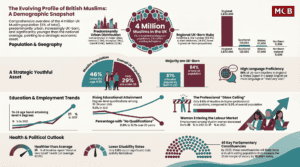
- There are 4 million Muslims in the United Kingdom, forming 6% of the population with the following breakdown.
In England, 3.8 million;
Wales, 67,000;
Scotland, 120,000;
Northern Ireland, 11,000.
The Muslim population is predominantly urban rather than rural based in key cities: in England – London, 1.3 million; in Wales, Cardiff, 34,000; in Scotland, Glasgow, 49,000; in Northern Ireland, Belfast, 5,500.
- Muslims are a kaleidoscope of communities – a microcosm of British society as a whole, with representation in all census ethnic groups, the largest being Asian (2,630,256; 66%) and Black (429,142; 11%). 6% of the Muslim population is of White ethnicity (234,016). There are even small numbers of Gypsy (or Irish Traveller) and Roma Muslims in the Census data. A greater proportion of Muslims are of mixed or dual ethnicity compared with other faiths in the UK.
- The average age profile of the Muslim population in the UK is skewed towards the younger age bands. Whilst in the overall population, 29% is under the age of 25 years, in the British Muslim population, it is 46%. The Muslim population’s youthful age profile is a strategic asset in an ageing society. This ‘demographic dividend’ contributes to meeting gaps in the labour market, contributing financially to the State welfare system.
- 10% of all school age (5-15 year old) children are Muslim and 22% of all Muslims fall in this age band. Only 5% of Muslims are over 65 as compared to 19% in the overall population.
- The majority of Muslims are UK born – 51% compared with 84% in the overall UK population. Of the UK’s 10 regions, Yorkshire & The Humber and West Midlands have the greatest proportion of UK Born Muslims, 60% and 57% respectively.
- In the UK born Muslim population in England & Wales (aged 3 years and over), English is the main language or spoken well or very well by 99%.
- The Government’s deprivation indices indicate that while 20% of England’s overall population resides in the 46 most deprived local authority districts, this applies to 40% of the Muslim population. This proportion has not changed over the last 20 years suggesting a lack of social mobility.
- The MCB has analysed the child population in local authorities that have a high Muslim population (20% or more) and are also among the most deprived, to assess the number of children being raised in poor neighbourhoods: there are about 400,000 children in these 14 local authority districts.
- Tracking trends in the overall population there has been an upward trend in the proportion of Muslims attaining a degree-level qualification. In the 16-24 age band those attaining level 4 degrees increased from 11% in 2001 to 21% in 2021.
- The proportion of Muslim men who are self-employed is higher than the rest of the population. Whilst this may reflect an entrepreneurial spirit, much of this self-employment is likely to be concentrated in the ‘gig economy’.
- The rise in the proportion of Muslim women in employment from 20% in 2001 to 31% in 2021 indicates greater entry and contribution in the labour market and the economy as a whole. With Muslim women being generally younger than women in the population overall they are much more likely to have caring responsibilities for young children and elderly relatives. Further increases in Muslim women’s labour force participation could be facilitated by more generous local resource allocation for childcare and adult social care as well as supportive measures from employers.
- The proportion of Muslims in the ‘Higher professional occupations’ category has increased over the last 20-years and stands at 6.5% in 2021. This is still however lover than the 9.0% of the population who hold such jobs overall. The lower proportion points to the potential of a glass ceiling felt by many British Muslims.
- A greater proportion of the British Muslim population in England and Wales is in ‘Very good or good health’ compared with the overall population: 85% compared with 82%. Similarly, a lower proportion have disabilities in which day-to-day activities are limited significantly and impact their quality of life. This is largely due to the Muslim population being younger than the overall population. The pattern changes when focusing on older age groups with older Muslims being much more likely to be in poor health than older members of the wider population.
- It is estimated that in 2029, there are likely to be 49 parliamentary constituencies where the Muslim voting population aged 16 or over will exceed the incumbent Member of Parliament’s 2024 margin of victory by 10,000 or more votes. The reasons for their voting choices will be varied, with some aligned to the broader population but some that appear more prevalent specifically amongst Muslim voters. Care must be taken to not assume Muslim voters to be a homogeneous block. The MCB conducts voter registration campaigns, most recently its ‘Hungry for Change – Have You Registered to Vote?’ drive prior to the May 2026 local government elections.
To download the full report please visit this interactive web report link here: https://mcb.org.uk/censusreport/
Notes to Editor: For media enquiries please email [email protected]